Ticket
The show ticket alone
A live performance in the theatre
- Length50 minutes
- Reviews9,062
- Cancellation24 hours
Guides
Language
Currency
Look up datesstarting at $7 · free cancellationPrice for your party
In brief
Vietnamese water puppet art began in flooded rice fields at harvest festivals, and puppeteers standing in the pool work lacquered fig wood puppets behind a screen.
Art essentials
Weigh up 3 options
Add your party and compare the three ways of watching.
≈
View≈
View≈
ViewThese from-prices come from GetYourGuide and are converted using the ECB reference rate; the exact price shows at checkout.
A plain guide to the village craft behind the Hanoi show: the flooded rice fields, the hidden puppeteers, the lacquered wood and the places where the tradition is still practiced.
Editorial team, waterpuppetshow.click · Updated November 16, 2026 · Allow 8 min
Summary view
Vietnamese water puppetry began in the villages of the Red River Delta at harvest time, when farmers gathered for folk singing and dancing. According to Vietnam's tourism authority, those village festivals began adding puppets roughly 1,000 years back, and the first stage was a rice field flooded with water once the crop was in.1,2 The theatre in Hanoi dates the tradition to the 11th century, which matches the authority's own description of the performances.9,3 The stage was a pond before it was a theater.
The art did not stay in the fields. The authority writes that in the 12th century, during the Ly dynasty, the country's finest troupes were picked to perform for the king and his guests.10 A craft that had belonged to farmers and festival crowds had reached the court, and that history is one reason the form is treated as serious art and not as a children's pastime, although children enjoy it as much as anyone.
Sources do not agree on a start date, and you should not expect them to. In Ban Thach village in Ninh Binh province an artisan told Viet Nam News that the villagers do not know the exact origin, and that tradition holds the art has existed for about 800 years.11 Dao Thuc village near Hanoi counts a puppetry history of its own, put at 300 years.12 Read those numbers as the age of one village's memory, not as the birthday of the whole art.
The parts of a show
| Part | What it does | Who says so |
|---|---|---|
| The pool | Serves as the stage, dressed with roofs and flags5 | National authority5 |
| The screen | Hides the puppeteers from the audience18 | Thang Long theatre18 |
| The poles and strings | Carry the puppets and move their arms4 | National authority4 |
| The puppets | Fig wood painted with lacquer4 | National authority4 |
| The musicians | Sit on both sides of the stage5 | National authority5 |
| The host Teu | Opens the show and leads the scenes6 | National authority6 |
Every row follows the source named in its last column, and the theatre's English pages read as a rough translation, so the wording here is ours.18
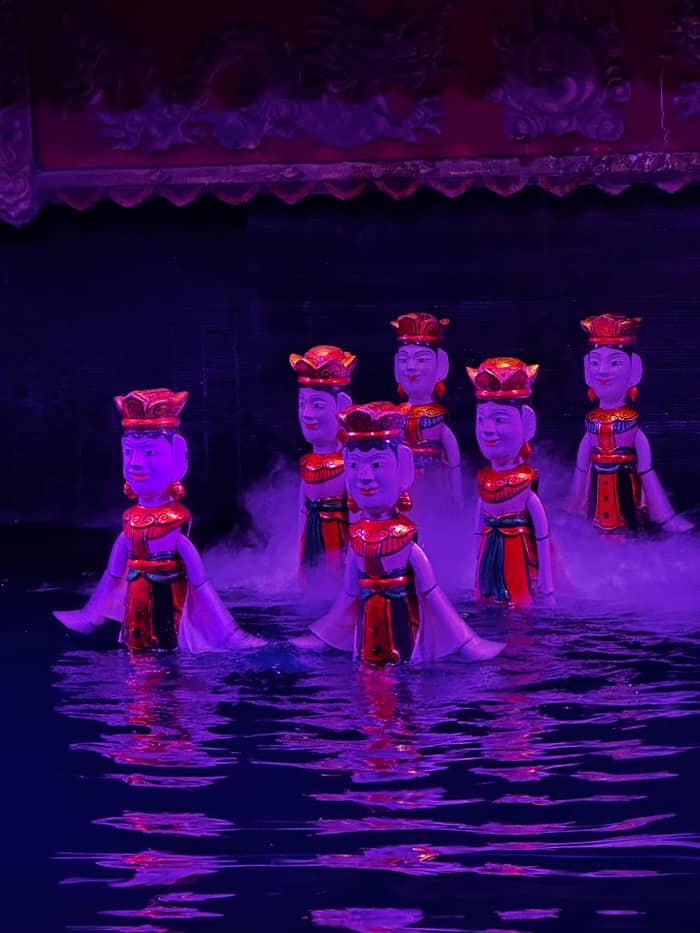
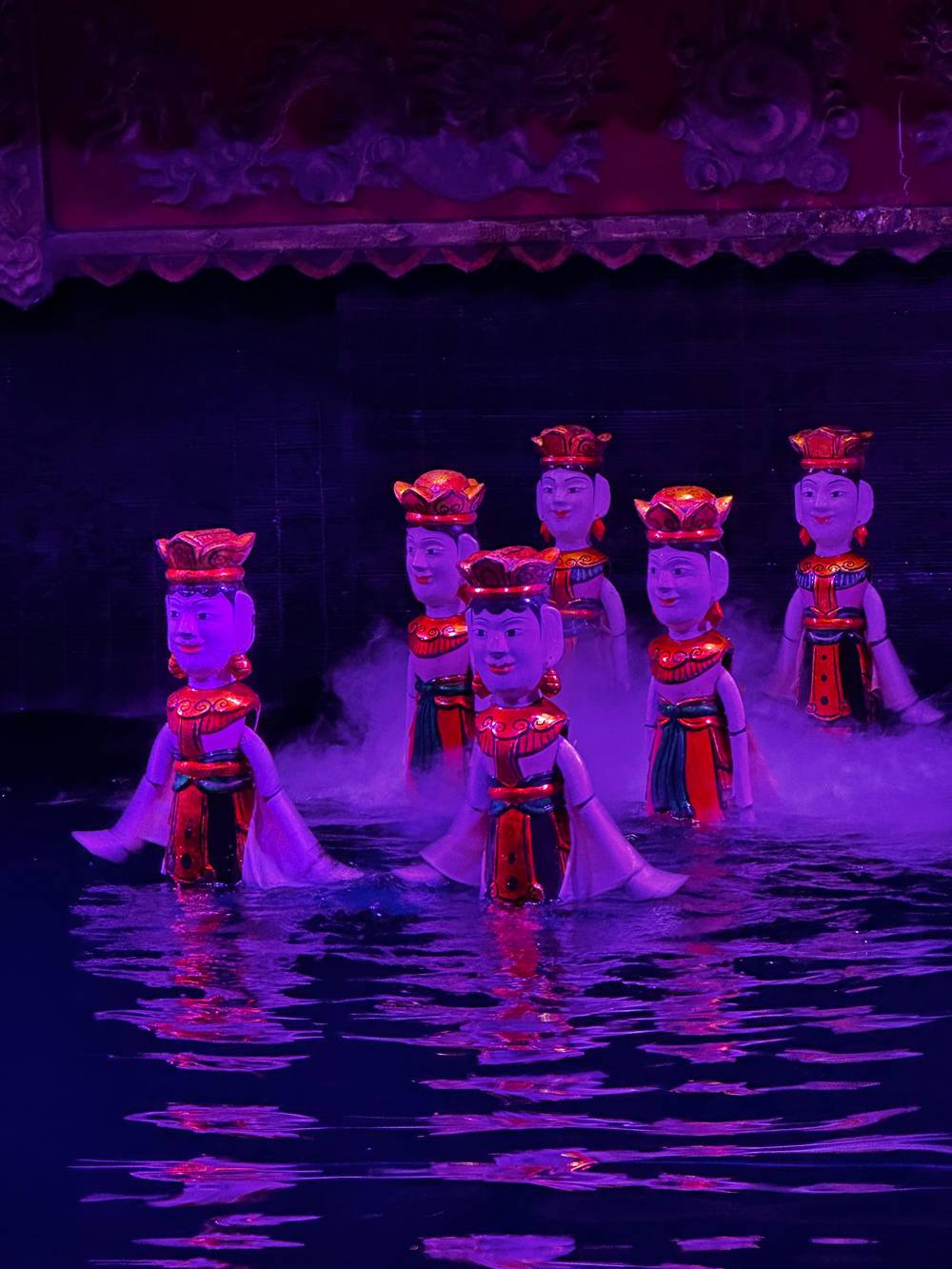
How do water puppets work, when you cannot see anyone moving them? The answer is that the people are there and the screen hides them. Puppeteers stay in the water for the whole show, using its motion to build the drama and polish the illusion.17 Vietnam Tourism describes performers wading waist-deep with bamboo poles behind a screen, working lacquered wooden figures that act out rural scenes.3
The Hanoi theatre explains the machinery in simple terms. A large bamboo pole holds each puppet beneath the surface, and the performers hide behind a curtain on the stage, so the figures appear to travel across the water alone.18 The tourism authority adds that the arms are moved with bamboo sticks and strings, and that it takes decades to become a master puppeteer.4 The glide you admire from your seat is the product of a very long apprenticeship.
Watch the surface as much as the puppets themselves. A ripple, a splash or a boat wake is part of the effect, and a good show leaves the water moving between scenes. Because the performers are hidden, every sense of weight and speed comes from the water, the poles and the strings you cannot see, and that is why a small puppet can seem to dive, rise and race across a whole pool with such ease.
How far back
Each bar is the age that one source gives for its own subject, not one shared timeline: the theatre's years of operation, the villagers' count of their own puppetry and the tourism authority's date for puppets at harvest festivals.16,12,11,1
The material matters more than the carving. The authority says the figures are cut from light fig wood that floats on the surface, then lacquered.4 In Ban Thach village the artisans recall that elders chose fig wood and jackfruit wood, both light, buoyant and durable when they are in constant contact with water.23 A puppet that floats and survives a daily soak is the basic requirement, and every other choice in the workshop follows from it.
After shaping and carving, the villagers apply several layers of varnish so that each figure takes on its own colors and expression, and they build in pivot joints, springs and movement shafts so that the puppets are lively and easy to control.24 The Hanoi theatre states that its puppets are made of wood and then lacquered.18 The result is a cast of bright, slightly comic faces made to read from a seat well back from the pool.
Few places still make them by hand. Vietnam Tourism points to Dao Thuc village on the outskirts of Hanoi, which it says keeps one of the last working puppet workshops and lets visitors learn how the figures are made.19 The village lies roughly 20 km from the center of Hanoi, and many residents live a double life, farming or working in offices and putting on traditional outfits to perform on certain occasions.12,25
Your way in
Start from your curiosity and the right stop appears below.
If I want to see how a puppet is built
Dao Thuc village
Vietnam Tourism names it as home to one of the last remaining workshops.19
If I want the show in a Hanoi theatre
The Thang Long theatre
It stands at 57B Dinh Tien Hoang, opposite Hoan Kiem Lake.20,21
If I want an open-air village stage
Yen Duc in Quang Ninh
The provincial portal says the stage is outdoors among fruit gardens and rice fields.22
If I want a puppet to take home
Fig wood and lacquer
These are the materials the authority names for stage puppets.4
If I only want the performance
The ticket alone
A live performance of 50 minutes, from $7.
Ways to see it
Ticket
A live performance in the theatre
Food walk
Old Quarter tasting, then the show
Bus tour
A bus ride with the ticket included
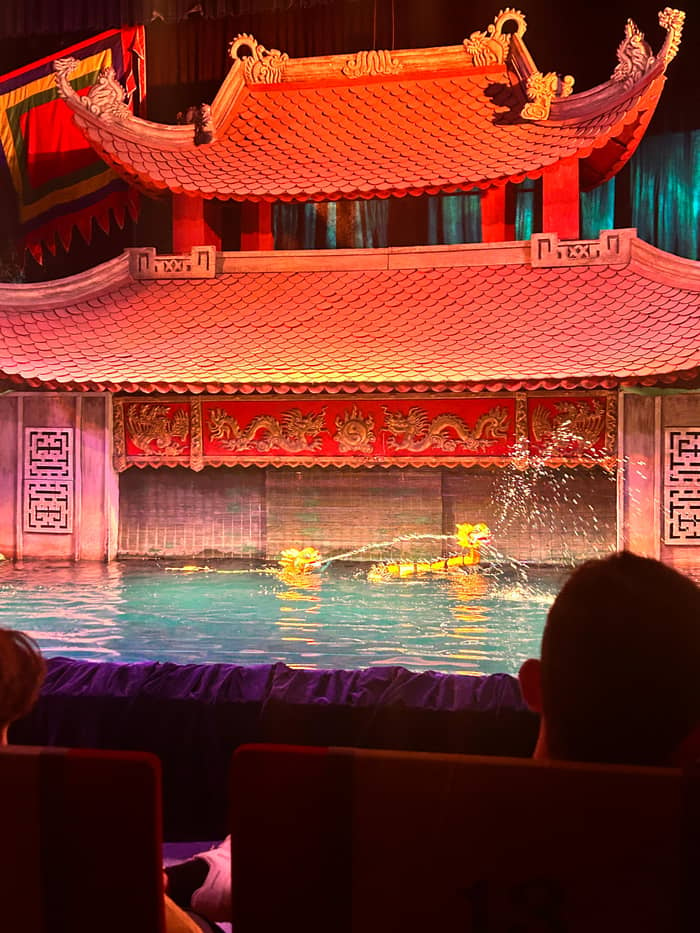
So what is a water puppet show in practice? A comic host, a run of village scenes and a live band, all played on water. Shows are no longer given in flooded paddies but in pools, with a pavilion of tiered red roofs hung with flags and parasols, a stand-in for the altar in a village communal house. The musicians sit on both sides of the stage and carry the stories through singing and traditional instruments.5
The Hanoi theatre names some of those instruments, such as the erhu and the zither, alongside a rowing song of the north.28 The same theatre lists a capacity of 300 seats, so the pool is seen from close range and the sound of the band fills the hall.8 The roofs and flags are a reminder of the village festival that gave the art its start, and they frame every scene like a small stage inside a larger one.
A traditional show begins by introducing Teu, the comic host, who leads the audience through the scenes that follow.6 The theatre describes Teu as a comic with license to tease about anything or anyone.29 After him come the scenes of village work and festivals: ducks driven to water, nets and fishing, rice transplanting, boats under oars and royal processions, with some folktales that always carry a moral.30 Our page on the scenes and the music takes them one by one.
From field to theatre
Harvest time
Farmers gathered for folk singing and dancing, and puppets joined the programme on a stage made from a flooded field.1,2
The royal court
Ly-dynasty kings had the country's finest troupes perform for them and their guests.10
Village ponds
In Ban Thach the puppeteers rehearsed by the village pond and set up a booth for festival shows.13
Village theatres
Ban Thach keeps a permanent theatre by the pond and 4 portable ones that can travel.14
Today's pools
Pools dressed like a communal house altar replace the paddies, with musicians on both sides.5
The city stage
The Thang Long theatre reports 5 to 7 performances daily, all year round.15,16
The national tourism site describes water puppetry as a treasured part of Vietnam's intangible cultural heritage.31 The Ministry of Culture, Sports and Tourism uses nearly the same words, presenting water puppetry as the nation's own traditional art and as intangible cultural heritage, in the plan for an international puppetry festival that it approved for Quang Ninh province.32,33 The label is official, and it also describes something still practiced by ordinary people.
The Hanoi theatre makes its own claims about continuity. It states that it has more than 55 years of history, a record in Asia for performing water puppetry without a day off for 365 days a year, and 5 to 7 performances daily.16,15 Those are the theatre's own statements, and you should read them as such. They do show that the show is a daily business in Hanoi and not a rare festival event, which is why you can plan an evening around it.
In the villages the picture is quieter. In Ban Thach, besides the permanent theatre by the village pond, there are currently 4 portable puppet theatres that can travel to festivals, and the shows draw large audiences at spring festivals and village celebrations.14,34 Our page on Yen Duc village looks at one of the village stages that foreign visitors can reach through the province of Quang Ninh, which keeps its own official list of places to see the art.
Video
Lily's Travel Agency on YouTube · Tap play to load the video; not before.
Puppeteers stand in water throughout the show, and use the movement of the water to create drama, perfect the illusion, and tell a story.
Before you go
Searches for water puppets for sale come from visitors who want a small piece of the show to take home, and the honest first answer is that no official source publishes a price list, so none appears here. What the sources do give you is a way to judge a puppet by what it is made of and where it comes from, which is more useful than a number that would be out of date within a single season.
Start with the workshop villages and the craft streets. Vietnam Tourism names Dao Thuc as the home of one of the last remaining water puppet workshops, which makes it the surest place to see how a stage puppet is made.19 In the Old Quarter, each of the 36 streets has been home since the 15th century to artisans who traded in the goods the street was named for, so the quarter is a natural place to look for hand-made goods.35 Ask the maker, not only the seller, how the puppet was carved.
Judge the wood and the finish. The tradition calls for light, buoyant fig wood painted with lacquer, and for pivot joints and springs inside the figure.4,24 A puppet that is heavy, glossy with plastic paint or fixed in one pose is a souvenir and not a stage figure. Most shops take cards, but street vendors work in cash, so keep some notes for small purchases.27 Check the size of the figure against your luggage and your airline before you commit to a large one.
The easiest place to see the art in the capital is the Thang Long theatre. Vietnam Tourism places it at 57B Dinh Tien Hoang in Hoan Kiem District and quotes admission from VND 100,000, while the theatre itself gives the same address.7,36,20 The theatre rates the show as fine for every age group, which makes it an easy evening for a mixed group.37 Check the theatre's own booking page for the current prices, since a listed fee can change.
Our own ticket is the Hanoi water puppet show ticket, a live performance of 50 minutes, sold from $7 and refundable up to a day before the show. It is a booking service for the same kind of seat, and it is not the theatre's own box office. If you want the history first and the show second, read this page, then book a seat, and use the other pages of this site for times, the address and the evening around it.
Outside Hanoi, the same art can be found in the provinces. Vietnam Tourism lists water puppet theatres in Hoi An, Hue and Ho Chi Minh City as well as the capital, and the Quang Ninh tourism portal names two places in its own province.38,39 None of them replaces the experience of the Hanoi pool for a first-time visitor, but they show how far the art has spread from the Red River Delta, and they give you a reason to look for a show in the next city on your route.
FAQ
Vietnam Tourism says it has one of the last remaining water puppet workshops and an outdoor stage.19
The Hanoi theatre rates the show as fine for every age group.37
Sources
Planning a Hanoi water puppet evening? Ask a real person here.