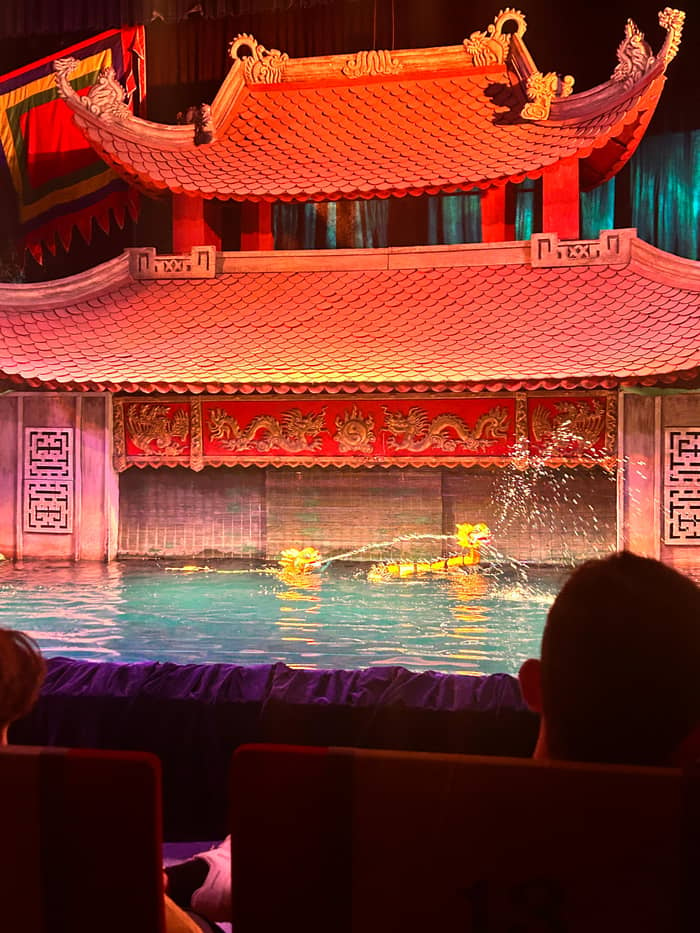
Ticket
The show ticket
The live programme in the theatre
- Length50 minutes
- Audio guideExtra, at the door
- Reviews9,062
Guides
Language
Currency
Look up datesstarting at $7 · free cancellationPrice for your party
In brief
The Hanoi water puppet show story is a run of short village scenes led by the comic host Teu, with a live band playing the erhu, flute, zither and monochord.
Programme essentials
Weigh up 3 options
Choose your party size to compare the totals.
≈
View≈
View≈
ViewThese from-prices come from GetYourGuide and are converted using the ECB reference rate; the exact price shows at checkout.
What happens on the pool from the first joke to the last dance, who the characters are, which instruments you will hear and what the language of the show means for you.
Editorial team, waterpuppetshow.click · Updated November 16, 2026 · Allow 7 min
Summary view
People who ask what water puppet shows are normally about are usually expecting one story with a beginning and an end. A traditional show is closer to a revue of village life. Vietnam Tourism says the puppets act out daily life in the northern villages, from ducks, fishing and rice fields to boats and royal parades, and that some scenes depict folktales that always carry a moral.2 Each scene is short and stands alone.
The Hanoi theatre says the pieces it performs were selected from more than 400 traditional water puppet pieces that circulated in folk tradition.7 That is a large menu, and it explains why two visitors can describe different evenings. The theatre also lists longer plays on its own site, including The Reed Flag Emperor, and a children's programme called Our World that it gives on special occasions such as Christmas and the Mid-Autumn Festival.8,9
For a summary you can carry into the hall, think of the show as a walk through a village year. It begins with a joke and a bow, moves through the work of the fields and the games of the children, pauses for a legend or two, and ends in the ceremonial dances that mark a festival. Nothing in it needs prior knowledge of Vietnamese history, although the history rewards the curious.
Scene guide
| Scene | What you see | What it stands for |
|---|---|---|
| Teu, the host | A comic who opens the show and links the scenes1 | Free to joke about any event or person11 |
| Dragon and phoenix | Dances in the style of festival processions13 | The dragon is an ancestor, the phoenix stands for love and fidelity13 |
| Buffalo flute | A shepherd boy and a peaceful village14 | Calm country life and a love of home14 |
| Farming | Plowing, transplanting, watering and harvest15 | The routine work of the Vietnamese farmer15 |
| Imperial exam | A parade with flags, soldiers and drums16 | Respect for learning and talent16 |
| Children swimming | Mischievous boys in the river17 | A way to cool off on a hot summer day17 |
| Sword Lake | The golden turtle and the king's sword3 | The origin of the name of Hoan Kiem Lake3 |
| Boat race | Teams racing in the festive season18 | Strength and team spirit18 |
| Lion dance | A unicorn or lion at a festival19 | Blessings and good luck19 |
Scene names and meanings are paraphrased from the theatre's English pages, which read as a rough translation, so treat the wording as a guide and not as a script.7
Teu, the comic host, is the first face of a traditional show, and Vietnam Tourism calls him a whimsical storyteller who walks the audience through the scenes and stories as they unfold.1 If you remember one character from the evening, it will be Teu, because he is the voice that frames the whole evening. Vietnam Tourism calls him an iconic character of the art, and he is the thread that ties the separate scenes together.
The Hanoi theatre describes the role in a similar way: Teu is a comic figure with a license to tease about any event or any person, and his frequent appearances become a way to build a bond between the audience and the puppet characters.11 That license explains why the humor feels different from one season to the next. You do not need to follow the words to enjoy the timing, the bobbing and the exaggerated bows.
Expect the humor to be physical as much as verbal. A puppet can pop out of the water in a new place, a paddle can send up a splash and a quarrel can end in a dive, all within seconds. A host like Teu gives that pace a shape, so that one short scene hands over to the next before the laughter has faded, and the audience is kept a step behind the joke in the best possible way, which is the point of the form.
The theatre in numbers
The farming scenes show the routine work of the Vietnamese farmer: plowing, transplanting, watering and harvest.15 The buffalo flute scene shows the peaceful life of a village, built around a shepherd boy and the sound of his flute.14 They are gentle scenes, and they are where the music matters most of all, because the melody carries the mood while the puppets move slowly across the pool.
The children's scene is the loosest and the funniest. It shows mischievous boys swimming together in the cool water of the river, and the theatre describes the fun as a way to melt away the heat of the summer day.17 The boat race that follows belongs to the festival season: the theatre says boat racing is a long tradition of the festive months that shows strength and team spirit.18 Expect splashing, paddles and a lot of energy.
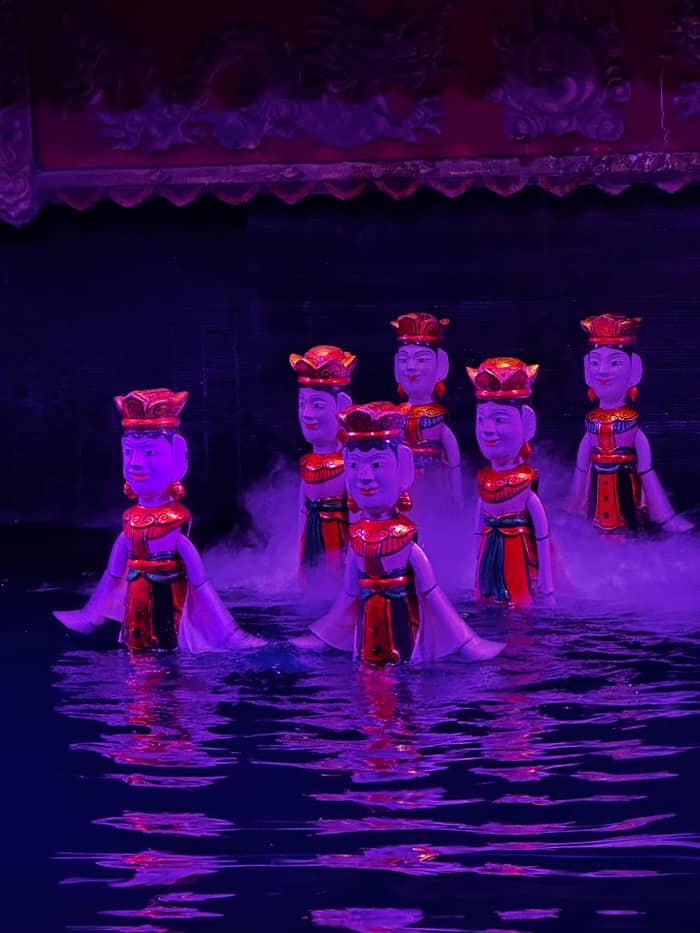
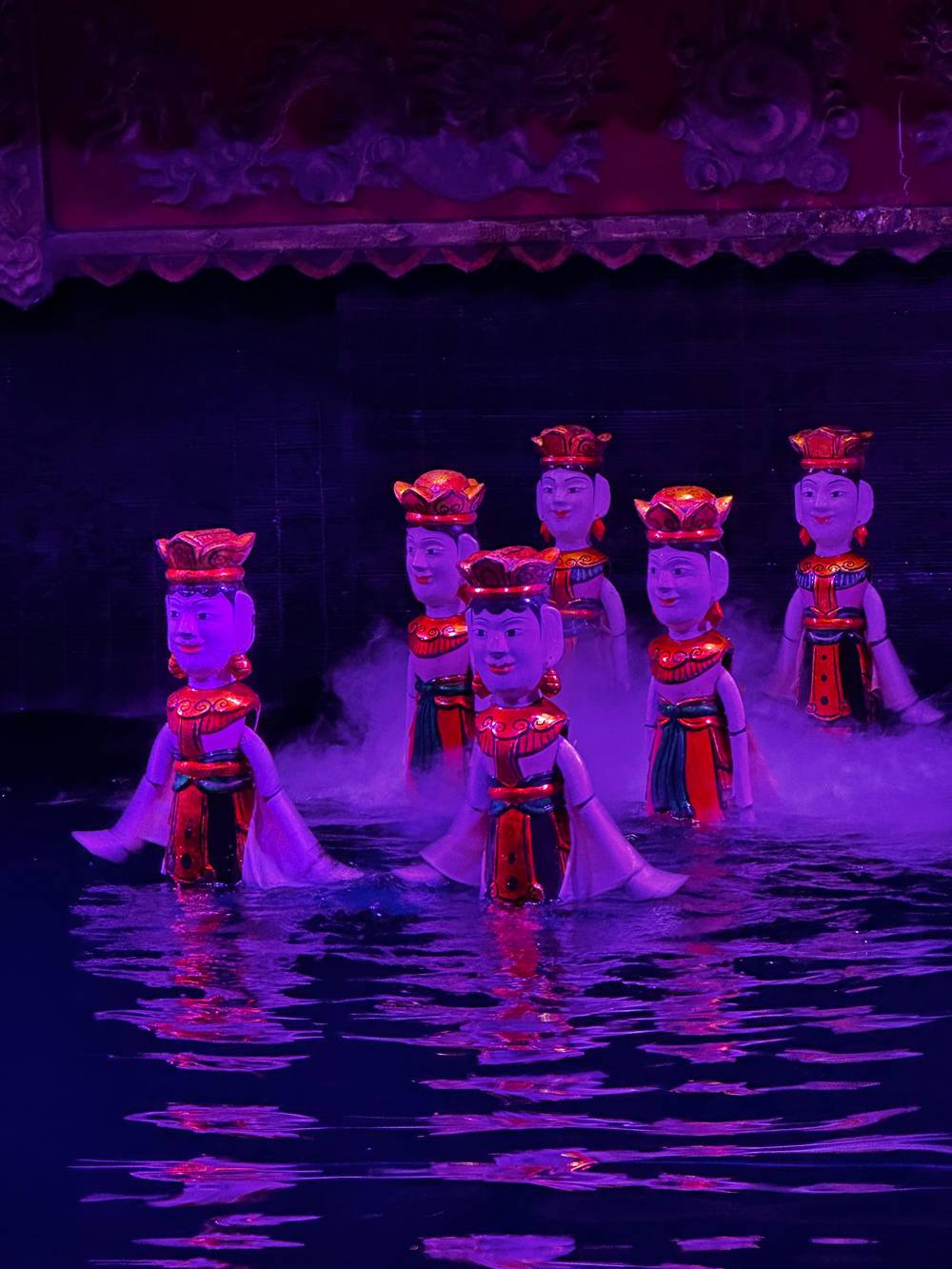
The scene with the lion dance changes the mood again. The theatre says the unicorn, or lion, is a mascot that brings blessings and good luck in the folk beliefs of Vietnam.19 It marks the part of the show that belongs to festivals and processions, when the village puts on its best clothes. Seen in order, these scenes make a year in the life of a rice village, from field work through play to celebration.
Audio guide
A few honest questions settle it.
If I will read the scene guide first
Skip the audio guide
The scenes are short and visual, and the programme is easy to read from the table above.7
If I want the names and legends explained live
Buy the audio guide
A guide is offered in 7 languages, outside the fare.6
If I am watching on a tight budget
Skip it
The guide costs extra, VND 50,000 per show in our listing.
If I am with young children
Bring them
Every age group is welcome, per the theatre.20
If I want to take photographs
Turn the flash off
Our listing says flash photography is not permitted.
Pick a way to watch
Ticket
The live programme in the theatre
Skip line
The same programme, Thang Long theatre
Food walk
Old Quarter tasting, then the programme
One scene belongs to Hanoi itself. It tells the legend of the Sword Lake: after a golden turtle claims back the sword from the king, the lake is named Hoan Kiem, the Sword Lake, which the theatre notes is now in the center of the capital.3 In Vietnam Tourism's version, a giant golden turtle from the lake handed the emperor a magical sword for his campaign against the Ming and collected it again once he was victorious.10 The lake lies just across the street from the theatre.
Another scene recalls the imperial exam. The theatre explains that successful candidates returned to their village in splendid clothes, with soldiers, flags and drums, and that the custom encouraged learning and respect for talent.16 Even if you miss the details, the parade is easy to read: banners rise, drums sound and the whole village seems to turn out to greet a native son who has done well.
The ceremonial dances close the sequence. The theatre says the dragon is regarded as an ancestor and is sacred in folk belief, and that the phoenix dance stands for love and fidelity.13 It adds the Tu Linh dance, which shows 4 sacred animals, among them the dragon, unicorn and phoenix.23 These are the most spectacular moments for photographs, but remember that flash is not allowed, as the ticket listing warns.
A scene in order
The gift
A giant golden turtle in the lake gives Emperor Ly Thai To a magical sword to defeat the Ming.10
The victory
After the victory the emperor holds the sword he was given.10
The return
The emperor returns the sword to the turtle, who dives down to bring it to the gods.10
The name
The lake is named Hoan Kiem Lake, or Sword Lake, now in the center of the capital.3
On the pool
The theatre lists the legend among the scenes of its programme.3
The show is a musical water puppet show in the plainest sense, because the band plays and sings throughout. Vietnam Tourism notes that the musical ensemble sits on both sides of the stage and brings the stories to life with voices and traditional instruments.4 The players are part of the picture, framed by the same roofs and flags as the puppets, and watching them work is part of the pleasure of the evening.
The Hanoi theatre names the erhu, the zither and the monochord among its instruments, and a song from the northern rowing tradition.5 The flute fits the buffalo boy, and the theatre mentions drums in its account of the parade that greets a successful scholar.14,16 If you close your eyes during a slow scene, you can hear how much of the storytelling is carried by the music, and how little of it depends on the words.
Do not worry about missing the words of the songs. The theatre links its music to the folk tradition of the north, and a rowing song suits a boat race well.5 Listen for how the music changes at the start and end of a scene, because the band plays the role of a narrator, and you will find that the programme is easy to follow even when the singing is in Vietnamese and you cannot follow every word.
Video
myVideoMedia on YouTube · Tap play to load the video; not before.
A traditional show always starts with an introduction to Tễu, the comedic host.
Before the lights go down
The theatre's page gives 50 minutes as the running time and adds that listening guidance exists in 7 languages but sits outside the fare.6 The ticket listings say the artists sing in Vietnamese. Read that carefully, because the information is the theatre's own and its English page is a rough translation that you should confirm on the day. On our ticket listing a guide can be added at the entrance for VND 50,000 per show.
Do you need the audio guide? If you read the scene list on this page beforehand, most travelers will follow the show without one, because the scenes are visual and the humor is physical. An audio guide helps if you like to hear names and legends explained as they happen, or if you travel with older children who ask questions. It is cheap enough to try on one show, and you decide at the entrance.
A short plan helps. Read the table on this page, note the scenes you most want to see, and arrive early enough to find your seat without hurrying. The show is open to every age group in the theatre's own words, so you can bring children without worry about the content.20 When the lights come up, you will have seen a compact, lively version of what a village festival once offered, and the walk back along the lake makes a good epilogue.
FAQ
Vietnam Tourism describes scenes of village life and some folktales, each with its own moral.2
The theatre names them, with a rowing song of the north.5
The artists sing in Vietnamese, while the theatre adds audio guidance in 7 languages as a paid extra.6
Yes, from the staff at the entrance, at VND 50,000 a show on our listing.
The theatre says a scene tells the legend of the Sword Lake, now in the center of Hanoi.3
The theatre's page puts it at 50 minutes.6
Sources
Planning a Hanoi water puppet evening? Ask a real person here.